From “It Works” to “It Scales”: My Django Journey
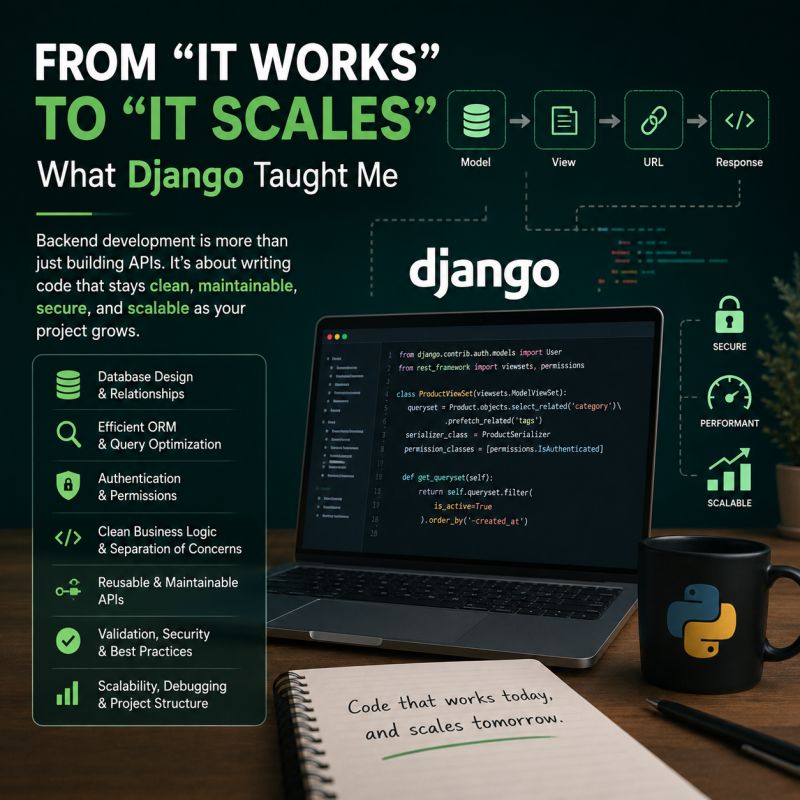
From “It Works” to “It Scales”: What Django Taught Me About Backend Development
When I first started learning Django, my approach to backend development was straightforward: define a model, create a view, configure a URL, and return a response. If the feature worked as expected, I considered the task complete.
However, as I started building more complex applications, I realized that making a feature work is only the beginning. A well-designed backend must also be secure, maintainable, efficient, and capable of handling future growth.
1. Database Design Is More Than Creating Models
One of the first important lessons I learned was that database design has a significant impact on the entire application. In Django, creating models with models.Model is relatively easy. Designing the right relationships between those models requires much more thought.
For example, a blog application might contain users, categories, tags, and posts. Each post may belong to a category, have multiple tags, and reference an author. These relationships should reflect the actual requirements of the application.
I learned to think carefully about when to use ForeignKey, OneToOneField, and ManyToManyField. I also started paying more attention to field constraints, database indexes, deletion behavior, and data integrity.
A good database design does not simply store data. It helps prevent inconsistent data, makes relationships easier to understand, and provides a foundation for efficient queries as the application grows.
2. Understanding Django ORM and Query Optimization
Django ORM makes database operations convenient by allowing developers to work with Python objects instead of writing SQL for every operation. But convenience does not automatically mean efficiency.
As I learned more about the ORM, I began to understand the importance of knowing what happens behind a queryset. A poorly written query can generate unnecessary database requests, increase response times, and create performance problems when a page displays many records.
Two particularly useful ORM tools are select_related() and prefetch_related().
select_related(): Retrieves related objects through SQL joins. It is useful for single-valued relationships such as foreign keys and one-to-one relationships.prefetch_related(): Retrieves related objects in separate queries and combines the results in Python. It is useful for many-to-many relationships and reverse relationships.
For example, when listing blog posts alongside their authors and categories, I can avoid repeatedly fetching related objects:
This is a small example, but it represents a bigger lesson: backend developers should understand both the code they write and the database work that code produces. Query optimization should be guided by actual query patterns and performance measurements rather than assumptions.
3. Authentication and Permissions Are Different
Authentication answers the question, “Who is the user?” Authorization or permission checking answers, “What is this user allowed to do?” Understanding this distinction changed how I approach API security.
A user being logged in does not automatically mean they should be allowed to access every resource. For example, a user may be allowed to update their own profile but should not be able to modify another user's profile or access an administrative endpoint.
In Django and Django REST Framework, authentication classes, permission classes, and object-level permission checks help enforce these rules.
I also learned that permissions must be checked on the server, not merely hidden in the frontend. API endpoints should enforce the correct access rules regardless of how a request is submitted.
For applications with different user roles, such as customers, sellers, and administrators, defining permissions clearly from the beginning can prevent serious security issues later.
4. Separating Business Logic from API Logic
As an application grows, putting every operation inside a view or API endpoint can make the code difficult to maintain. A view that handles request validation, database updates, business rules, notifications, and response formatting becomes harder to understand and test.
This taught me to think more carefully about responsibilities. API views should primarily coordinate the request and response, while business rules should be organized in appropriate places that can be reused and tested independently.
For example, consider an e-commerce application. Calculating an order total, applying a discount, checking inventory, and updating stock are business operations. They should not become tangled with HTTP response formatting.
Depending on the project's complexity, business logic can live in dedicated service functions or modules, model methods, domain-specific components, or other appropriate structures. The goal is not to follow one rigid pattern; it is to make responsibilities clear.
A clean separation helps when the same operation needs to be called from multiple API endpoints, background jobs, or administrative workflows. It also makes changes less likely to break unrelated parts of the application.
5. Validation Should Protect the Data
Input validation is another area where my understanding has improved. Accepting data from a client does not mean that data is valid or safe to use. Requests may contain missing fields, incorrect values, unexpected types, or data that violates business rules.
Django REST Framework serializers provide a structured way to validate incoming data and transform it into Python data types. Custom validation can enforce requirements that go beyond basic field-level checks.
For example, a wallet API should reject a negative deposit amount. An order API should check whether the requested quantity is available. A registration endpoint may need to ensure that a particular username or email address is acceptable under the application's rules.
I also learned that validation should exist at the appropriate layers. Serializers help validate API input, business logic enforces domain rules, and database constraints protect data integrity when applicable. No single layer should be expected to solve every validation problem.
6. Transactions and Data Consistency Matter
Some operations involve multiple database changes that must succeed together. If only part of the operation succeeds, the application may end up with inconsistent data.
Consider transferring money between two wallets. The application must debit the sender, credit the receiver, and record the transaction. These steps cannot safely be treated as unrelated updates.
Django's transaction.atomic() helps group database operations into a transaction so that a failure can roll back the changes made within that transaction.
This is a structural example rather than a complete wallet implementation. Financial operations also require careful handling of concurrent requests, balance checks, database locking where appropriate, and duplicate requests.
The wider lesson is that a successful HTTP response is not enough. The underlying data must remain correct, even when operations fail or multiple requests occur at the same time.
7. Building Reusable and Maintainable APIs
An API is more than a collection of endpoints. It is a contract between the backend and its clients. Consistent response structures, meaningful HTTP status codes, predictable error messages, and appropriate pagination make that contract easier to use.
In Django REST Framework, serializers, viewsets, generic views, permission classes, and pagination can help reduce duplication when used appropriately. Reusable components also make it easier to keep behavior consistent across endpoints.
However, reusability should not mean forcing unrelated features into the same abstraction. Code should be shared when the responsibilities and behavior are genuinely similar. Otherwise, an abstraction can make the application more complicated instead of less complicated.
I now pay more attention to naming, module structure, clear responsibilities, and predictable API behavior. These details may seem small at first, but they become increasingly valuable as a project gains new features and contributors.
8. Security Is a Continuous Responsibility
Security is not a final checklist that can be completed just before deployment. It influences how the application is designed, how data is validated, and how users interact with the backend.
Important practices include keeping secrets outside source control, configuring production settings properly, using HTTPS, enforcing authorization checks, limiting exposed data, and keeping dependencies maintained.
Django provides useful security protections, but those protections still need to be configured and used correctly. For example, a production application should not expose detailed debug error pages to the public, and API responses should not reveal sensitive fields simply because those fields exist on a model.
I have come to see security as part of good backend engineering, rather than a separate task to consider after the main features have been implemented.
9. Testing Makes Refactoring Safer
Code that works for one example may still fail under different conditions. Testing helps identify those cases before they become problems for users.
Django's testing tools and Django REST Framework's API test utilities make it possible to check model behavior, business rules, endpoint responses, authentication, and permissions.
For example, tests for a transfer endpoint should consider not only a successful transfer but also insufficient funds, invalid amounts, transfers between different tenants, unauthorized requests, and failures that should leave balances unchanged.
As I continue improving my development workflow, I recognize that testing is particularly valuable when changing existing code. A useful test suite provides confidence that a refactor or new feature has not silently broken established behavior.
10. Scalability Starts with Good Decisions
Scalability is often associated with advanced infrastructure, additional servers, caching systems, queues, and distributed services. These tools can be useful, but they cannot compensate for every problem caused by poorly designed application logic.
For a Django application, scalability begins with practical decisions: efficient queries, suitable database indexes, pagination, sensible caching, well-defined responsibilities, and reliable background processing when appropriate.
It is also important to measure performance before introducing complexity. A small application may not need a distributed architecture, a separate service for every feature, or a caching layer for every endpoint.
The goal is to build a system that can evolve without requiring unnecessary rewrites. That means understanding the application's actual requirements today while leaving room for reasonable growth tomorrow.
Conclusion: Beyond Making Things Work
My journey with Django has gradually changed how I think about backend development. I started by focusing on individual features and whether they produced the expected response. Now, I pay more attention to the decisions behind those features: how data is structured, how queries are executed, how permissions are enforced, and how the code will behave as the project evolves.
I am still learning these concepts through building projects, solving problems, reading documentation, and improving my existing code. There is always more to understand, especially when working with performance, concurrency, security, and production systems.
A good backend is not simply one that works today. It is one that can be understood, tested, maintained, and improved tomorrow.
I will continue building with Django and Django REST Framework, focusing not only on delivering features but also on understanding what makes software reliable and maintainable over time.